


It is well known that chiropractic care is one of the best ways to naturally and effectively treat common musculoskeletal conditions such as lower back pain, neck pain, and headaches. However, chiropractors can treat other musculoskeletal conditions, including one that is extremely common but rarely discussed. Temporomandibular Joint Dysfunction (TMJD) is a condition that affects the jaw joint, which allows the mouth to open and close. TMJD is actually the second most common musculoskeletal disorder behind lower back pain, affecting 12% of the population at any one time. Common symptoms of TMJD include jaw pain, jaw clicking or popping, difficulty chewing, and even associated conditions such as neck pain and headaches.
The temporomandibular joint is very unique. Similar to joints such as the knee, it is a hinge joint, meaning it moves back and forth in a single direction (as the mouth opens and closes). The joint is located just in front of the ear, where the mandible bone meets the temporal bone of the skull. Between these two bones is a disc made of fibrocartilage that cushions and supports the joint. As the mouth opens, the disc slides forward with the joint to maintain support and comfort in this motion. When TMJD occurs, the disc is usually displaced from its normal position. This can lead to various symptoms and overall discomfort, prompting people to seek treatment.
Traditionally, TMJD has been treated by oral care providers through treatments such as splints or implants, Botox injections, and even surgery. Often, these treatments are quite costly yet don’t fully address the root cause of the problem. At Balanced Living Chiropractic, we have received advanced training in the diagnosis, treatment, and management of TMJD using completely natural methods. Our doctors can address the root cause of the problem and help you get back to feeling the way you want, in a cost-efficient and safe manner.
How Our Care Plan Works
1. I Feel Heard & Not Crazy
Many patients tell us this is the first time they’ve felt truly listened to. During your consultation and exam, we slow things down, ask the right questions, and create space for your full story—without rushing, dismissing, or minimizing your experience.
2. You Did More Than The Last 10 Doctors Combined
It’s because we slow down and look deeper. Every exam and X-ray is intentional, detailed, and designed to uncover the root cause—not just manage symptoms.
3. Wow, It Is Already Working
We use X-rays before and after treatment to measure real change. By comparing them, patients can see how their spine responds, helping to build confidence in the adjustments and in the body’s natural ability to heal.
4. I Finally Feel Normal Again
After struggling with chronic pain, headaches, or nerve issues, many patients tell us, “I finally feel normal again.” Our precise adjustments and thorough care help restore balance to the spine and nervous system, allowing the body to function the way it was meant to.
How We Treat TMJ Dysfunction In Rochester Hills, MI
Comprehensive Consultation and Exam
If you visit our office to discuss the problems you have had with TMJD, the first step will be the consultation and exam. During the consultation, our doctors will listen to your story so they can better understand the struggles you have experienced in living with and managing your TMJD pain. Even though TMJD is a very common condition, the impact it can have on people’s lives is very real. That’s why our doctors want to listen to your experiences and understand the impact it has had on your life.
Following the consultation will be a detailed examination. Our doctors will perform several orthopedic and chiropractic tests because TMJD is commonly a root cause of other conditions in this area, such as headaches and neck pain. For best results, it is important to address all aspects of TMJD, so the importance of these additional tests cannot be emphasized enough. Overall, the consultation and examination process will give our doctors a detailed understanding of you, your condition, and the extent to which it has affected your life.
Specific 3-D Digital X-Rays in Rochester Hills, MI
This is the most important step in our office to determine how to address and adjust your neck to get rid of your TMJD symptoms. We take three specific views that help us form a 3-D image of your neck and jaw alignment, and we measure down to the thickness of a fingernail to find the problem. By looking at this closely, we’re able to adjust you with no popping, twisting, or cracking. Most of our patients say they can barely feel the adjustment happen, but can start to feel changes instantly!
Specific Chiropractic Care
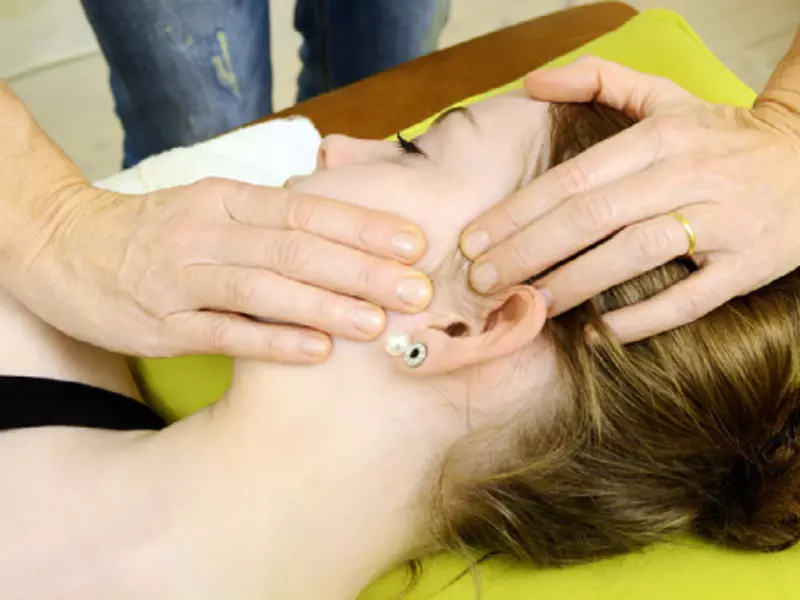
At Balanced Living Chiropractic, our doctors take a 360-degree approach to treating TMJD. One key element of this is chiropractic care, not only for the TMJ but also for the upper cervical spine (C1-C2 vertebrae). In a similar fashion to the spine, the TMJ is a joint where two bones meet by way of a fibrocartilage disc. When this joint and/or disc becomes displaced, gentle chiropractic adjustments can help restore alignment and reduce pain. At Balanced Living Chiropractic, we use NUCCA/Orthospinology adjustments to perform this correction, allowing the adjustment to be effective while remaining comfortable for the patient.
In addition to adjusting the TMJ, it is very important to assess the cervical spine. Dysfunction of the cervical spine can alter the mechanics of the TMJ, which can lead to related conditions such as neck pain and headaches. Specifically, our chiropractors will check your neck for subluxation, a condition in which vertebrae in your cervical spine shift out of normal alignment, irritating the adjacent nerves. By restoring normal alignment of the neck and correcting TMJ dysfunction, our doctors can help you feel better than ever before!
Frequency Specific Microcurrent (FSM)
FSM is an exciting new treatment for nerve pain, muscle pain, and many other conditions, using specific frequencies and micro-amperage current. FSM also uses the resonance effects of frequencies on tissues and conditions to create beneficial changes to symptoms and health.
Microcurrent is current measured in millionths of an ampere (amp). Micro-amperage current is the same kind of current your body produces on its own within each cell. The current is very small — there is not enough current to stimulate sensory nerves, so the current flow cannot be felt. FSM is a very effective tool for calming nerves, muscles, and joints and helping them function correctly, which helps reduce TMJD symptoms and address the underlying problem.
Nutrition Guidance
One element that often gets overlooked in treating TMJD is the lifestyle element. Specifically, how is what we’re eating or drinking helping or hurting the situation? Remember, the TMJ is the main joint involved in chewing food. There are certain foods that, although they taste good, can prevent your TMJD from properly healing. First, foods that are very chewy need to be avoided. This includes foods such as steak or beef jerky. These foods require a lot of chewing to break down properly, which can cause tension and fatigue in the TMJ muscles. Choosing softer foods is best during treatment.
Other foods to avoid include hard candy and chewing gum. Hard candy requires a lot of force to break, which has been known to exacerbate TMJ problems. Chewing gum is one of the worst things you can do, because it applies constant, repetitive stress to the joints themselves as well as the muscles that move the joint. Finally, caffeinated beverages should be limited, because caffeine is a stimulant that can increase muscle tension, which can negatively affect the TMJs. Overall, being mindful of what you eat can accelerate your healing from this painful condition.




Common Symptoms of TMJ Dyfunction in Rochester Hills, MI
Jaw Pain
Perhaps the most common symptom of temporomandibular joint dysfunction is jaw pain. It typically presents as a deep ache in the TMJ and can also be felt as ear pain and/or facial pain. Because the TMJs move so frequently for actions such as chewing, talking, and laughing, TMJ pain is usually fairly constant. This unrelenting nature tends to be what makes it so difficult for people to deal with.
So, what can cause jaw pain? There are quite a few possibilities, but some tend to occur more frequently than others. One example is recent dental work — a trip to the dentist often requires holding your mouth open for long periods of time, which puts a lot of stress on the TMJs and the surrounding muscles. Another common example is trauma, such as a motor vehicle accident. When these occur, it is impossible to predict what kind of injuries will happen, but it is common for the jaw to sustain damage. If you are experiencing jaw pain, it is quite likely to be a symptom of a greater problem such as TMJD.

Jaw Popping/Clicking
Another common indicator of temporomandibular joint dysfunction is jaw clicking or popping. These terms refer to the audible sound that accompanies jaw movement as the mouth opens or closes. It is possible to also experience pain with clicking or popping, but that isn’t always the case. Some people experience only the clicking or popping, and for them it’s more of an annoying nuisance than anything.
The primary reason jaw clicking or popping occurs is jaw movement into a displaced disc. If the disc is displaced too far forward, the mandible will contact the disc during opening and closing movements, creating the audible sound. To address this problem, the disc must return to its correct position between the mandible and temporal bones so the TMJ can move smoothly and properly.
Jaw Locking
In more serious circumstances, the TMJ’s articular disc can displace so far forward that it blocks the mandible from moving forward and fully opening. This essentially “locks” the jaw and prevents proper range of motion. This can be very painful and have a profound impact on a person’s quality of life, making it very difficult and uncomfortable to eat, chew, talk, laugh, and more.
The first step to addressing a locked jaw is to help the muscles relax. Heat and gentle massage techniques can ease the muscle tension that adds restriction to joint movement. Once the muscles are relaxed, they can help bring the joint and disc back into alignment. When the joint finds its normal position, it can resume functioning as a normal TMJ.
Jaw Clenching
It’s fair to say that everyone has clenched their jaw at some point in their lives. For some people, however, it’s a chronic issue that has led to a more serious problem such as TMJD. There are many reasons people clench their jaw, or in other words, bite their teeth together with excessive force. Stress and anxiety tend to be two of the most common causes, and many times people don’t even realize they’re clenching their jaw. In fact, it can even happen while you’re asleep, which can lead to discomfort the following morning.
Prolonged jaw clenching can lead to excess muscle tension and the development of adhesions in the muscles surrounding the TMJ. Over time, this tension becomes more and more problematic and can even cause tension headaches in addition to TMJD discomfort. Stress-relieving practices such as yoga and meditation are highly recommended to help reduce daily stress, which can lead to decreased jaw clenching and, in turn, less discomfort in the TMJs.
Difficulty Chewing
It can be immensely frustrating not to be able to enjoy certain savory foods, such as a nice steak. For those who have difficulty chewing due to TMJD, however, this is the unfortunate norm. With so much built-up muscle tension around the TMJ, those muscles fatigue much more quickly, making it nearly impossible to chew steak properly so it can be adequately digested. Not being able to chew food properly can have a serious impact on a person’s quality of life.
If you are having difficulty chewing your food, the underlying cause must be addressed. If it’s a muscle issue, the muscle tension needs to be alleviated so your TMJs can have a proper range of motion and muscle tone. If it’s due to a locked jaw, the jaw must be properly aligned before normal chewing function can be restored. Balanced Living Chiropractic has the best chiropractors in Metro Detroit to help address your TMJD naturally.
Check Out Our Location Near You
441 S Livernois Rd #205, Rochester Hills, MI 48307
Frequently Asked Questions About TMJ Dysfunction
Can chiropractic help with TMJ?
Absolutely. At Balanced Living Chiropractic, our chiropractors have advanced training in diagnosing, treating, and managing all types of TMJ disorders. They have achieved fantastic results for people who have been told they just have to live with their problem for the rest of their lives. If you are experiencing TMJ dysfunction, they are ready to help you.
How do you permanently fix TMJ?
The best way to fix a TMJ problem is to restore the temporomandibular joints to their normal range of motion and ensure that the muscles surrounding the TMJ are balanced in strength and flexibility. This is ideal; however, things can happen in life that are out of one’s control and can cause issues to recur, such as trauma from a car accident. Events like this can cause the recurrence of a previous TMJ problem, but the same treatment protocols should be put in place to ensure a swift return to optimal TMJ function.
Can chiropractors crack jaws?
Chiropractors can safely manipulate the temporomandibular joint to improve the range of motion and reduce pain. The chiropractors at Balanced Living Chiropractic use gentle techniques like NUCCA and an activator instrument, which delivers a gentle impulse to help adjust the joint. This is more comfortable for patients and just as effective, if not more effective, as traditional chiropractic adjusting protocols for TMJ.
What happens if TMJ is left untreated?
Like any problem in the body that isn’t addressed, it will continue to worsen. This can present as continued muscle tightness to the point where the jaw may lock and become difficult to move. Associated conditions such as headaches, neck pain, ear pain, and facial pain are also more likely. Remember, pain is your body’s way of telling you something is wrong; it must not be ignored. If you are having TMJ pain, today is the day to do something about it.
Can you fix TMJ without surgery?
Definitely, using the right muscle and manipulation techniques, most cases of TMJ can be corrected conservatively without the use of medications, injections, or surgery. As always, there are cases where these are indeed necessary, but the majority can be significantly improved with natural, conservative treatment measures. Balanced Living Chiropractic has the experience and training to help you achieve relief from TMJ dysfunction.
